Pastafarianism: The Letter That Started a Church
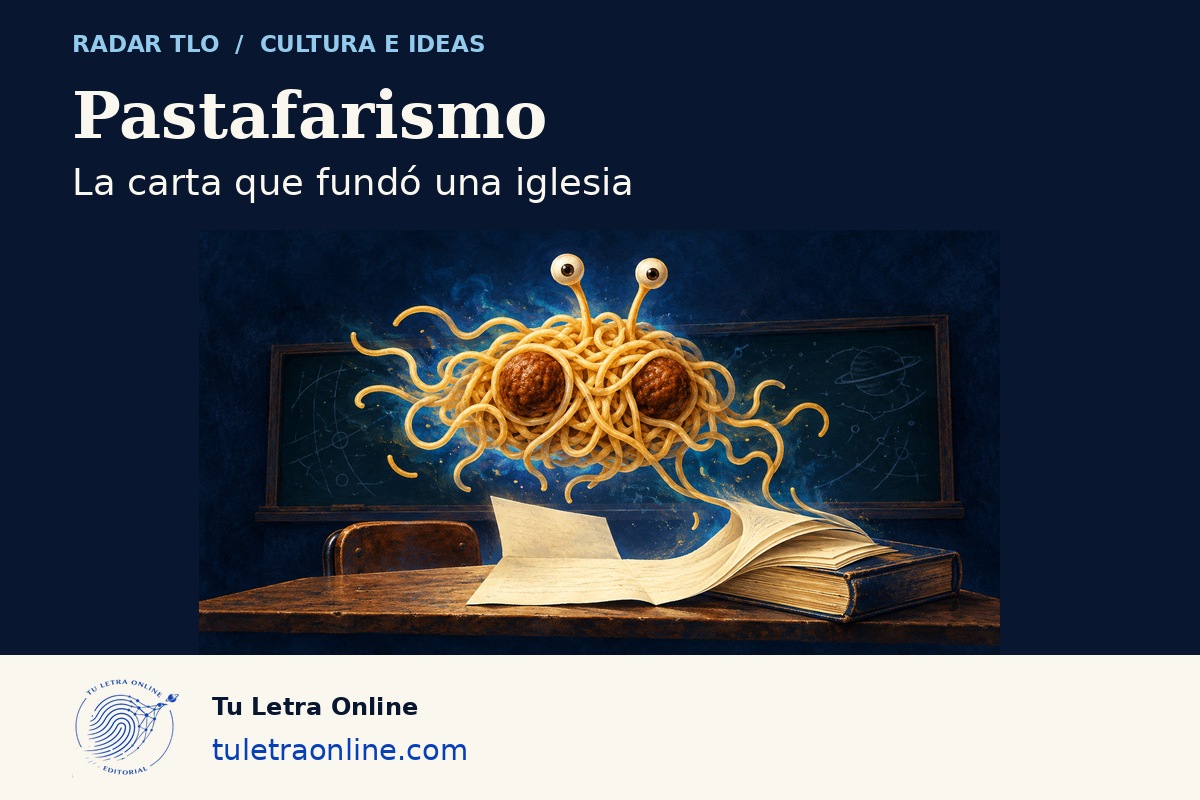
In 2005, Bobby Henderson proposed that science classes in Kansas teach about a creator made of spaghetti. His satirical argument gave rise to a movement and, later, a published gospel.
A letter to the education authorities became an origin story. Bobby Henderson wrote it to challenge plans to teach intelligent design alongside evolution in Kansas. He pushed the premise to an uncomfortable conclusion: if one supernatural explanation could enter the classroom as science, the Flying Spaghetti Monster deserved a place there too. That intervention gave rise to Pastafarianism in 2005.
What began as an argument about education also tells a story about writing: how a text written to challenge an idea can give a community its characters, symbols and vocabulary.
#A Letter from One Citizen
The document doesn’t present itself as a joint complaint from parents. It’s addressed to the Kansas State Board of Education and signed by Henderson as a “concerned citizen”. It concerns the proposal to teach intelligent design alongside evolution.
One detail can muddy the chronology: the page reproducing the letter has “2006” in its heading. Yet the organisation itself dates the letter’s public appearance to 2005. A Wired interview published on 22 December that year was already documenting the movement. The date in the page heading therefore can’t establish when it began.
#Absurdity as a Critical Tool
Henderson constructed a reductio ad absurdum. He demanded the same treatment for his creature as for other supernatural explanations, and claimed it could alter scientific measurements to conceal its intervention. The letter also posited a far-fetched link between declining pirate numbers and global warming. All of this was part of the satire.
The argument can be read as a test of consistency: accepting one exception means explaining why others are rejected. The spaghetti creature exposed that problem through an image that was easy to remember but hard to include in a school curriculum with a straight face.
#When Satire Becomes a Book
The move into print came with The Gospel of the Flying Spaghetti Monster. Villard published the 192-page paperback on 28 March 2006. Penguin Random House lists it under humour and literary criticism.
Once published as a book, the text could be read differently. The letter had intervened in a specific controversy; the book gave readers something they could return to and pass on, expanding the world of the original conceit. For a publisher, that shift is particularly intriguing: an argument gains a life beyond its first occasion when it finds a narrative form that others can recognise and share.
The book’s commercial categories help place it, but they don’t determine how each reader relates to it. A book can circulate as humour while also becoming a touchstone for a community.
#Belonging Without Literal Belief
In its account of itself, the organisation says that members needn’t take its scriptures literally and that sceptics are welcome. It also values the experience of community. That’s how it describes itself; it doesn’t tell us what every participant thinks or allow us to reduce their motives to just one.
This raises one of the story’s most fruitful questions: what can a narrative do when its readers know it’s an invention?
Pastafarianism lets us explore that question without deciding the answer in advance. A deliberate fiction can help people challenge authority, share symbols and form bonds. Henderson’s letter began by demanding an impossible place in the classroom. What followed opened up a much wider space for readers to make a story their own.
As an Amazon Associate, the publisher earns from qualifying purchases. It costs you nothing extra.
- pastafarismo
- religión y sátira
- textos fundacionales