Pablo Martín Sánchez wins National Translation Award for ‘Places’
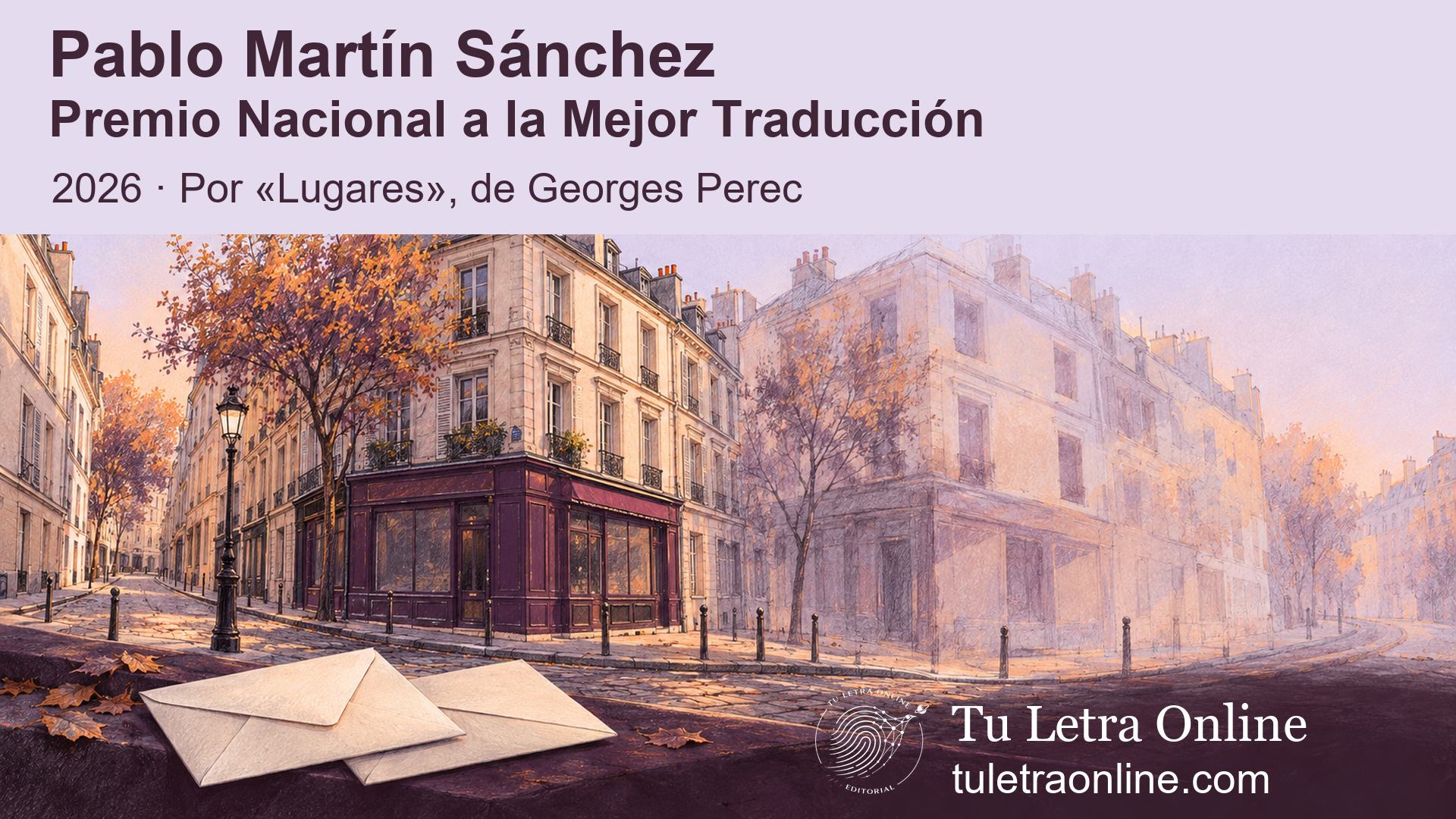
Sometimes precision means leaving something uncorrected. In awarding the prize to the translation of Georges Perec’s Places, the jury singled out an unshowy and particularly delicate task: identifying and respecting the inconsistencies of an unfinished work. On 15 October 2026, the Ministry of Culture announced that Pablo Martín Sánchez had won the National Award for Best Translation and Olivia de Miguel the National Translation Award for Lifetime Achievement. The first of these awards gives us a chance to ask where editorial care ends and the reshaping of someone else’s book begins. (cultura.gob.es)
The discussion has continued. Radio Nacional de España’s A Language Without Borders devoted its 26 October edition to the two translators. The programme’s introduction focuses on the difficulties and beauty of their craft. That attention is worth sustaining beyond the announcement of the awards. We should ask not just who won, but what decisions allow a work to reach readers in another language. (rtve.es)
A place seen and a place remembered
Anagrama published Places in Spanish on 2 April 2025, translated by Pablo Martín Sánchez. The publisher lists it at 824 pages and explains the plan behind the project. Perec would write about twelve places in Paris connected with his life, both by observing them directly and by recalling them from memory, over twelve years. The award is recent, but this edition has been out for some time. Keeping the two dates distinct helps explain why the work is back in the conversation now. (anagrama-ed.es)
The preface included in the publisher’s sample explains this separation in more detail. Perec wanted to describe what he saw while visiting a place and, at a different time, evoke it from memory. He then put the texts in sealed envelopes. The aim wasn’t simply to record streets, but to reveal how places, memories and the writing itself changed. This account draws on that sample and the award documentation, rather than a reading of the volume in full. (anagrama-ed.es)
The method suggests a fruitful exercise for any writer: let description and recollection produce different versions, without forcing them into immediate agreement. You could try it with a square, a room or a familiar street corner. Write first from memory, then from observation, and ask what belongs to the place and what the observer has added. There’s no need to reproduce the project’s elaborate structure to explore that gap.
Faithfulness can mean leaving the rough edges
According to the jury’s citation, translating Places meant cross-checking scattered fragments, preserving the critical apparatus and recreating wordplay using the possibilities of Spanish, including newly coined words. The award, then, doesn’t simply celebrate prose that reads naturally. It recognises the research, comparison and verbal invention involved. The ministry’s documentation identifies these tasks as particular strengths of the translation. (cultura.gob.es)
There’s an important distinction here for readers and editors. A contradiction may be an oversight worth correcting, but it may also reflect the state in which a manuscript has come down to us. Editors should ask what evidence allows them to decide between the two. Smoothing out every irregularity could make for easier reading
- traducción literaria
- Georges Perec
- edición