Prix Pascal: writing with AI without laying the writer bare
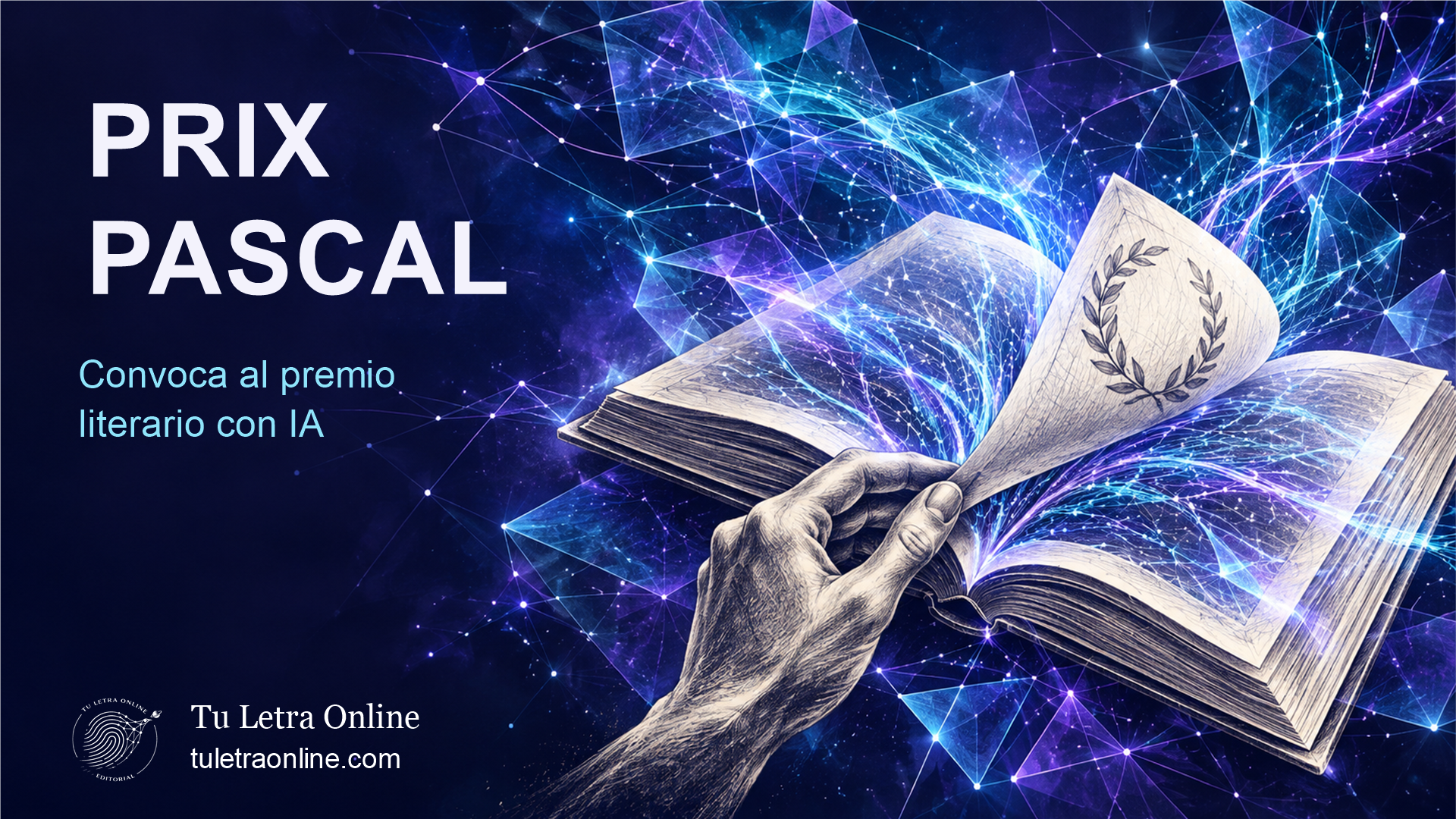
The French prize accepts self-published works and asks writers to explain how they used AI to create them. At Tu Letra Online, we welcome that openness, with one qualification: transparency should also protect the writer’s knowledge and tools of the trade.
A writer can explain where a novel began: a book, a film, a conversation. They can acknowledge the tools they used and the decisions they made. But their workshop also holds knowledge built up over years: how to find a voice, sustain a scene or make a tool serve their intentions. When a prize asks to step inside that workshop, it’s worth asking how far it needs to go.
The Prix Pascal de Littérature IA is holding its first competition in France for works created with artificial intelligence. The official website gives 20 October 2026 as the opening date for entries; the rules PDF gives 21 October. A check on 26 October confirmed that the entry portal was available, with a deadline of 30 November 2026 at 23:59 Paris time.
An opening for self-published writers
Writers of any nationality can enter, but their work must be in French, and self-published books are eligible, including those published through Amazon KDP. Books published by traditional publishers are excluded. This is how the prize defines its particular requirement that a work be unpublished. Official eligibility requirements.
Entrants must submit three things: an initial proposal of roughly 4,000 characters, known as the graine, or seed; an anonymous manuscript of around 300,000 characters in PDF format; and a two-page technical dossier. Rules, Article 3. For our French-speaking community, this opens up an opportunity worth considering carefully.
Alternative publishers: where is the line?
The distinction between self-publishing and traditional publishing leaves a question for writers working with emerging presses, publishing services or hybrid arrangements: how will their eligibility be decided?
An ISBN doesn’t settle that question: it identifies an edition, not who owns the copyright. KDP also allows writers to self-publish using either their own ISBN or a free one supplied by the platform. Hong Kong ISBN Agency; KDP documentation.
The contract is what determines which rights remain available. A company may provide editing, typesetting and distribution without taking an exclusive licence; a small press may acquire one. Nor does publishing with a press necessarily mean transferring ownership of the work: the agreement sets out which uses are authorised and on what terms. WIPO guide to publishing and intellectual property.
One plausible reason for the exclusion would be to avoid prior commitments that could make it difficult to publish the winning work. That’s consistent with the announced prize, but the organisers haven’t confirmed it as their reason. Nor does the distinction establish that the prize is seeking writers without a publisher’s backing so it can exploit their material.
Our question is straightforward: if what matters is whether the author can authorise publication, why classify entries by publishing route rather than specify which rights the author must retain? Clarifying this would allow fairer treatment of cases that fall between the categories and make the scope of the competition clearer.
Drawing inspiration, transforming it and answering for what you write
Here, writers declare their use of AI from the outset. We think that’s healthy: it means the work can be discussed with that knowledge in hand. It’s also important to consider where the material comes from and guard against the appropriation of other people’s writing. But acknowledging a tool, checking originality and disclosing a writing strategy are different questions that call for different treatment.
Literature feeds on reading and rereading. Lovers kept apart by their families, journeys that change those who take them, homecomings that unsettle a household: the same situation can recur in very different works. A shared motif or structure doesn’t, by itself, establish plagiarism. The appropriation of someone else’s specific expression calls for a different kind of scrutiny.
A film might spark a scene; a passage read years ago might suggest a rhythm. Between that first impulse and the new work lie the writer’s transformations, perspective and decisions. This exchange between literature, film and theatre was part of the creative process long before AI. Using a new tool brings responsibilities, but we must still be able to distinguish influence from imitation and copying.
The competition’s requirements also need clarification: the PDF prohibits manually inserting pre-existing human-written text by third parties; the entry form omits that qualification and makes an exception only for the seed. That difference affects which processes are permitted and needs to be resolved before writers enter.
How much of the workshop does the jury need to see?
Submitting a seed may help the jury understand the intention behind a work. Naming the model used also provides context. Our concern arises when writers are asked to describe their method in enough detail for another author to take it up and modify it: that requirement appears in both the rules, Article 1, and the entry form.
The dossier runs to two pages; that isn’t the same as requiring a full transcript of every conversation. Even so, the privacy policy lists source code, generation logs and model versions among the dossier materials. Such broad scope calls for clear limits.
For a writer who knows these tools, a sequence of instructions may distil months of testing: how to sustain a voice, divide up tasks, revise scenes or avoid predictable responses. Prompts, the instructions given to the model, and the way they’re organised may form part of the writer’s tools of the trade. Asking writers to explain their method in enough detail for someone else to reproduce it may come close to asking them to hand over what they’ve learnt.
The rules state that the manuscript and dossier remain the entrant’s property. The privacy policy limits their use to the jury and committee for administering and assessing entries. Rules, Article 8; privacy policy. We should acknowledge those safeguards. Our question concerns the level of detail required and how the knowledge it reveals will be protected.
The uncomfortable question is this: if the prize collects methods capable of producing good work, what guarantees do authors have that those methods won’t be reused to train or improve AI models? We’ve found no evidence that the Prix Pascal is gathering these materials for that purpose, or that it has a model of its own. Its stated purpose is to administer the competition. We’re asking for clarity: the restrictions on use should explicitly cover the texts, instructions and strategies submitted. Literary recognition should protect this part of the writer’s knowledge too.
The concern also extends to uses that don’t require training a model: reproducing a sequence of instructions or turning someone else’s strategy into a working system. These possibilities justify asking for safeguards; we’re not claiming that they’re happening in this competition.
Transparency within limits
At Tu Letra Online, we believe in proportionate disclosure: declaring where AI was used, explaining the extent of the human contribution and taking responsibility for the originality of the result. Authors should be able to retain control over instructions and strategies they need to keep private. If assessing a technical innovation requires examining them, it must be clear what writers are handing over, who can see it and which uses are permitted.
The prize’s interest in new methods explains its focus on process. That, too, deserves discussion: a new method can produce a poor book; a familiar one, an extraordinary work.
As we argued in ‘AI as the New Pencil: The Prize, Suspicion and the Work of Writing’, the writer’s judgement remains decisive. We invite you to return to that discussion. Quality demands intention, reading and the ability to revise, as well as command of the tool.
The Prix Pascal promises publication and exposure, but its rules don’t spell out the financial terms. Article 7. Before entering, it’s worth clarifying both what that offer entails and how much the dossier must disclose. We welcome a space opening up for these works. We also believe that recognising the process should mean protecting the person who developed it.
What does a jury need to know to judge fairly? Which parts of a method should a writer be able to keep private? How do we distinguish influence from appropriation without demanding that writers lay their entire workshop bare whenever they create something? We invite you to make your case, share your experience and disagree respectfully.