What did physicists believe outside the laboratory? A book to spark conversation about science and spirituality
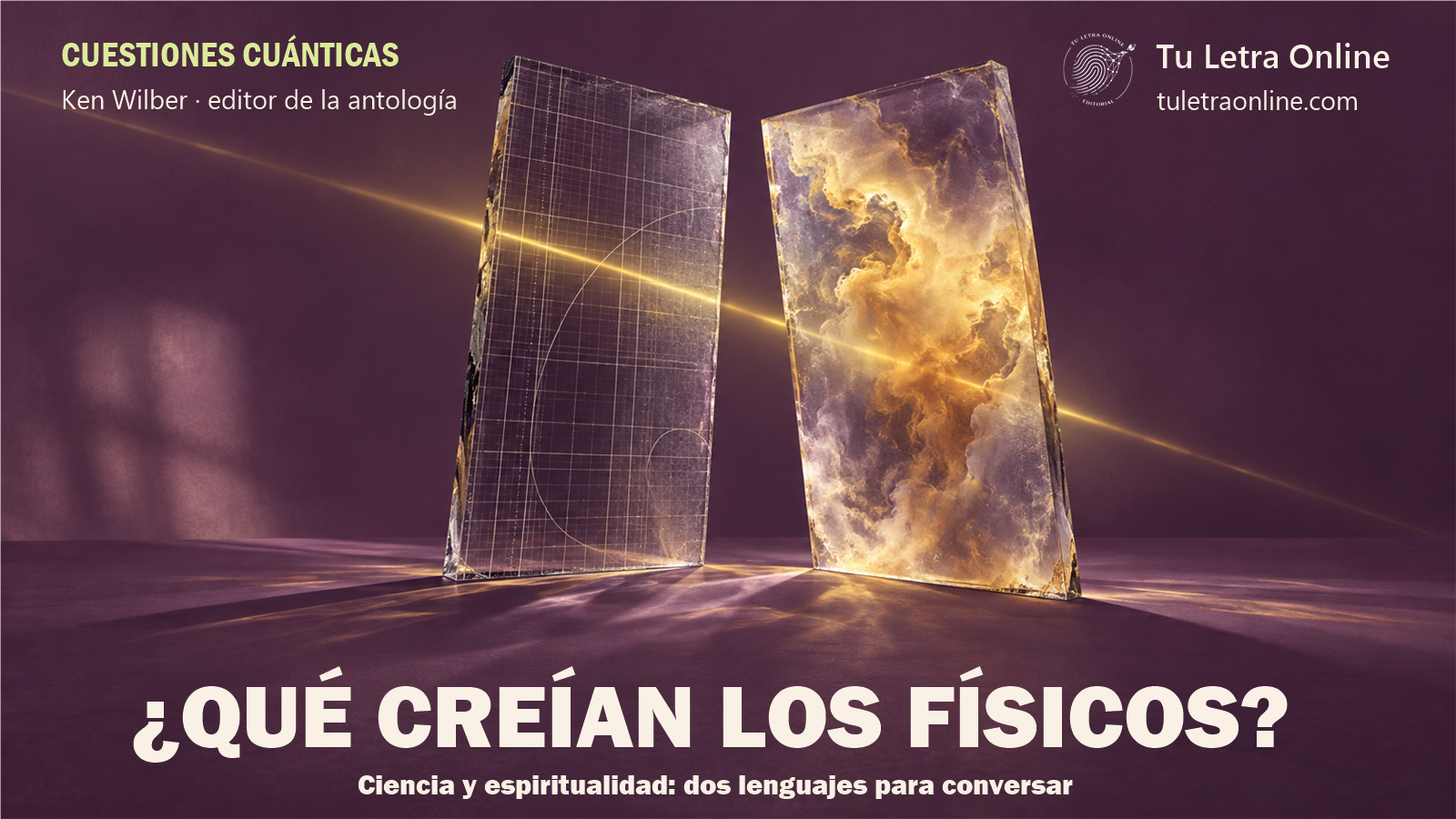
In Quantum Questions, Ken Wilber gathers leading scientists’ reflections on questions that reach beyond their work. The anthology invites us to explore a fruitful distinction: what someone believes, what an experience means and what an experiment gives us grounds to claim.
One way to approach a scientist is to stop asking them for answers. Instead, we become interested in what troubles them, what room they make for mystery and how they live with the questions their work leaves open. That curiosity guides our approach to this book: listening to people who helped transform our understanding of the world as they ask what it means.
After our look at Fritjof Capra’s The Tao of Physics, it’s worth turning to someone else. Quantum Questions, edited by Ken Wilber, lets us continue the conversation between science and spirituality from a different starting point. We can examine the relationship between these two ways of knowing without taking their compatibility for granted.
A library of voices, an editorial choice
The Spanish edition from Kairós runs to 304 pages and was translated by Pedro de Casso. The publisher’s catalogue describes a collection of writings by physicists including Heisenberg, Schrödinger, Einstein, Planck, Pauli and Eddington. Wilber’s role here is to select and edit the texts. That distinction matters: this is an anthology of voices, arranged from a particular perspective. Editorial Kairós book details.
For those of us who write and edit, that form matters. Selecting texts creates a conversation: it brings together people who worked in different circumstances and suggests a path between them. Readers can enjoy that encounter while also asking which connections the editor makes and which they find for themselves.
Nor do we need to imagine a shared doctrine behind all these names. The publisher’s account of their spiritual affinities is an interpretation to be tested against the texts. The contributors’ scientific reputations make the conversation interesting; readers must still decide whether an argument persuades them.
The shift Wilber proposes
The preface to the 2001 English-language edition, available in Everand’s public preview, takes a position that may surprise anyone expecting scientific confirmation of their beliefs. Wilber argues that the collected physicists’ spiritual reflections don’t amount to proof of mysticism through physics. He values both pursuits and rejects any attempt to reduce one to the other. Preview of the book, published by Shambhala, on Everand.
In the original preface, he also raises a provocative objection: if a spiritual philosophy depends on a scientific theory, that philosophy becomes vulnerable to changes in the theory. The question is worth considering even if you disagree with his position. Are we trying to understand an experience better, or secure an authoritative seal of approval for it?
That tension gives us room to read with curiosity. Someone may find that contemplation transforms their life and want to describe it. Someone else may recognise something familiar in that account. Examining what each understands by knowledge opens a philosophical conversation; demonstrating a physical mechanism would require a different kind of work.
This article draws on the prefaces and the opening of the introduction available in that preview, alongside the publishers’ descriptions. It’s an invitation to explore the book, grounded in those sources, not a claim to have read every chapter.
What we can take into the laboratory
Entanglement offers a concrete contrast. The 2022 Nobel Prize in Physics recognised Alain Aspect, John F. Clauser and Anton Zeilinger for their experiments with entangled photons, their tests demonstrating violations of Bell inequalities and their contributions to quantum information science. The official account describes specific experimental procedures and results. Popular science background from the Royal Swedish Academy of Sciences, PDF.
Physics, the American Physical Society’s magazine, explains how those tests developed and how researchers worked to close potential experimental loopholes. That context helps us see what it takes to support a claim in physics: making predictions and testing them against measurements. Michael Schirber, Quantum Entanglement Unveiled.
Those studies don’t, in themselves, prove anything about the meaning of a life, a religious doctrine or the power of a wish to change events. Connecting them to any of these questions would require specific arguments and evidence. Recognising those limits lets us appreciate the discovery while leaving room for other questions.
The pact between writer and reader
For our publishing community, this raises a question of language. A word can move from one field to another and gain expressive power. Describing memories as ‘entangled’ can illuminate a human relationship. If a text suggests that those memories interact through a quantum process, readers need to know what supports that explanation.
Taking care over that shift also serves spiritual writing well. It lets an image, an experience or an interpretation carry its own weight. Wonder can inspire research, meditation or a poem; each path has its own questions and standards.
Reading Wilber with that care offers an appealing possibility: discussing an idea without demanding that mystery disappear or turning mystery into an answer. The book can help us think through our differences. They give us something to think about, write about and listen to.
Let’s open the conversation
- What do you hope to find in a book that brings science and spirituality together: explanations, experiences, questions or a mixture of these?
- When does a scientific metaphor help you understand something, and when does it start promising more than it explains?
- How much weight do you give a scientist’s personal beliefs when assessing their philosophical arguments?
We invite you to make your case, share your reading and experiences, or disagree respectfully. The conversation is part of reading this book, too.
As an Amazon Associate, the publisher earns from qualifying purchases. It costs you nothing extra.
- Ken Wilber
- Cuestiones cuánticas
- ciencia y espiritualidad
- física cuántica
- ensayo
- filosofía
- lectura crítica.